Immediate output
Use only when the A/C or controller already provides the required internal restart delay, or when the connected load does not need compressor protection.
A sudden campground power interruption can stop an air-conditioner compressor while refrigerant pressure is still uneven. RVShield lets you choose when output returns—so the restart timing can match your equipment.
See what happens inside a rooftop A/C after a brief outage, then compare RVShield's three selectable restart delays.
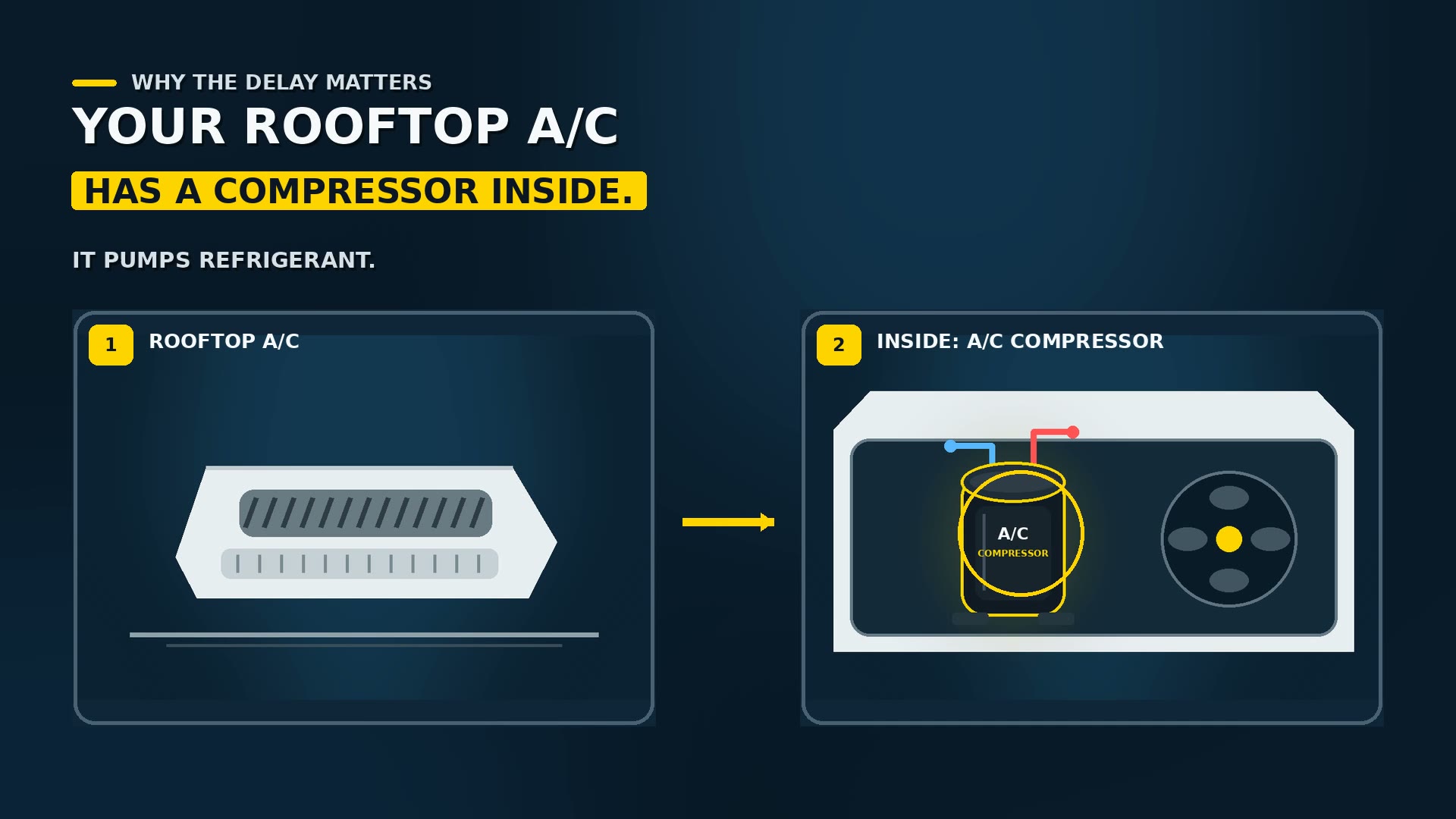
Your rooftop A/C contains a compressor that circulates refrigerant. If power disappears while it is running, high- and low-side pressures may need time to equalize.
Restarting too quickly can ask the compressor to start against that remaining pressure. The result may be a difficult start, increased current, a protective trip, or extra mechanical and electrical stress.
The delay starts after RVShield confirms that incoming power is safe to reconnect. Your A/C manufacturer's requirements still take priority.
RVShield separates incoming-power recovery from output reconnection, keeping the RV supply off during the selected countdown.
RVShield checks that the campground source is within its safe operating limits.
The selected 0-, 30-, or 180-second countdown determines when output may resume.
Once the countdown ends, RV power is reconnected for the equipment's own controls to operate.
These examples show why model-specific instructions matter. Features can differ between A/C units, thermostats, and control boxes—even within one brand.
| Brand / example | Representative guidance | Original source |
|---|---|---|
| Dometic FreshJet | Wait at least three minutes before restarting after a manual shutdown. | FreshJet manual (PDF) → |
| Coleman-Mach | Some compatible thermostats include a built-in three-minute anti-short-cycle delay. | Thermostat manual (PDF) → |
| Furrion Chill | Certain controllers and thermostats apply about a three-minute compressor delay after a power event. | FACW12PA-BL manual (PDF) → |
| GE Appliances RV rooftop A/C | Wait at least three minutes after shutdown before restarting the compressor. | Owner's manual (PDF) → |
Keep the essential campground checks, fault guidance, and power-safety references in the RV—not just in a browser tab.