How RVShield RVPM-30A detects, responds to, and logs nine categories of shore power threats — and why the engineering choices we made matter for real-world RV use.
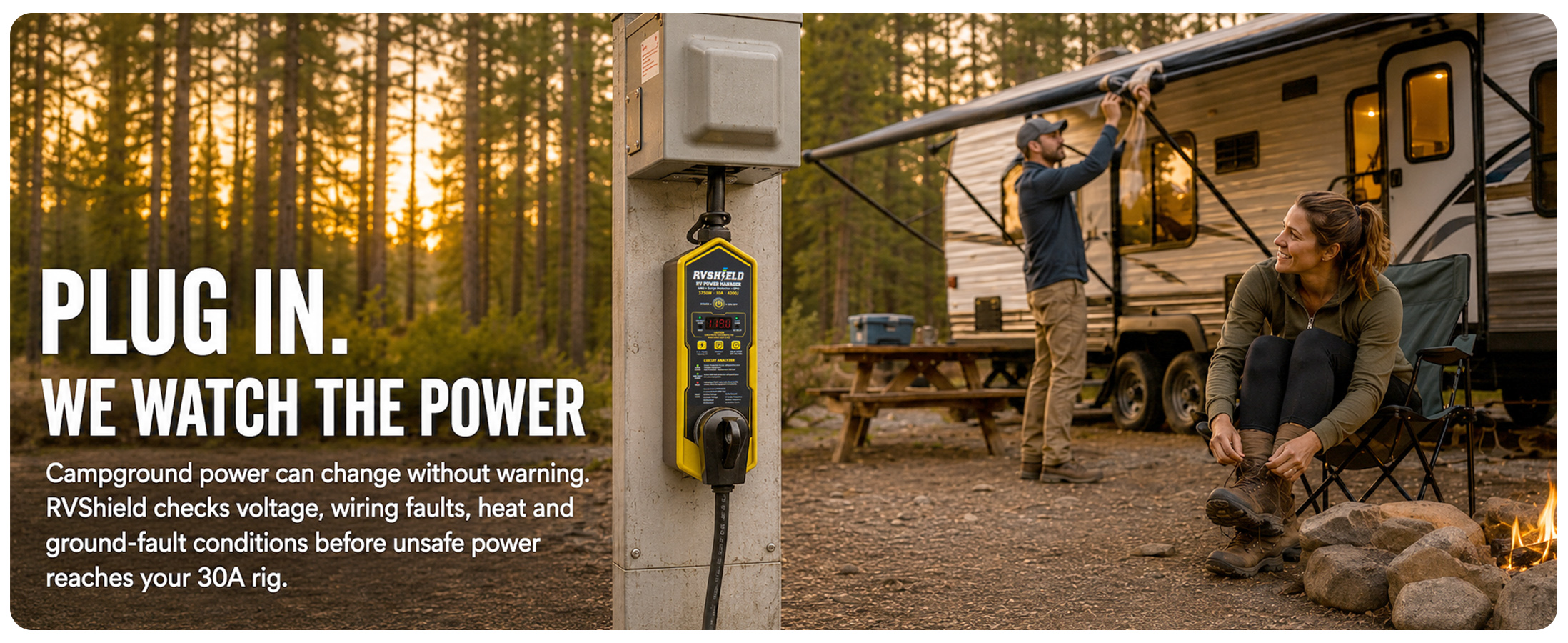
When lightning strikes a power grid several miles away, or a large motor on your campground's circuit kicks off, a voltage transient travels down the shore power line and into your RV. RVShield absorbs that energy before it reaches your appliances.
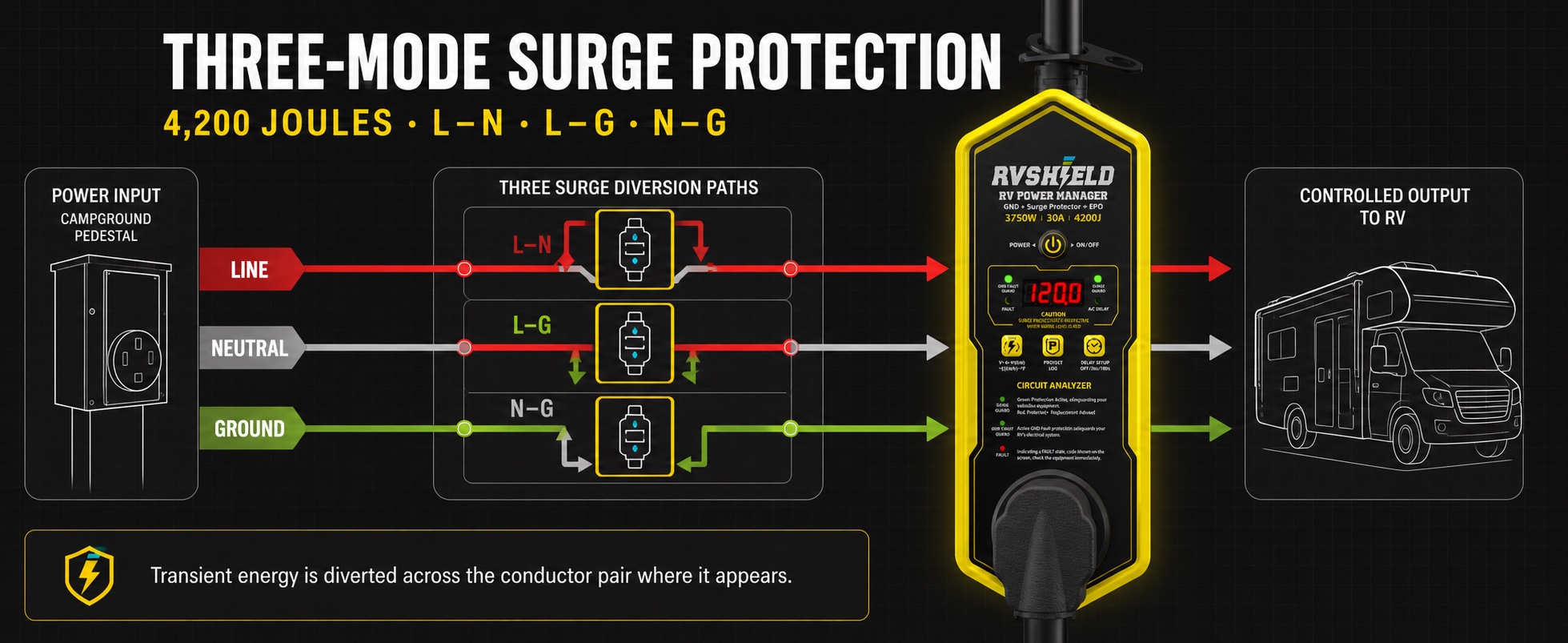
The RVPM-30A is rated for 4,200 joules of surge energy absorption and 6,500 amperes of peak surge current — the total energy a surge protector can handle before its Metal Oxide Varistors (MOVs) degrade.
Most surge protectors absorb surges in only one mode: Line to Neutral (L-N). RVShield absorbs in three simultaneous modes, covering every electrical path a surge can travel.
A single-mode protector misses surges that travel through the ground or neutral wire — a common path for lightning-induced surges at campgrounds with grounding issues. Three-mode protection closes all three pathways simultaneously.
Line to Neutral. The primary surge path in most campground wiring scenarios.
Line to Ground. Critical for lightning-induced surges entering via the ground conductor.
Neutral to Ground. Protects against surges between the neutral and ground conductors.
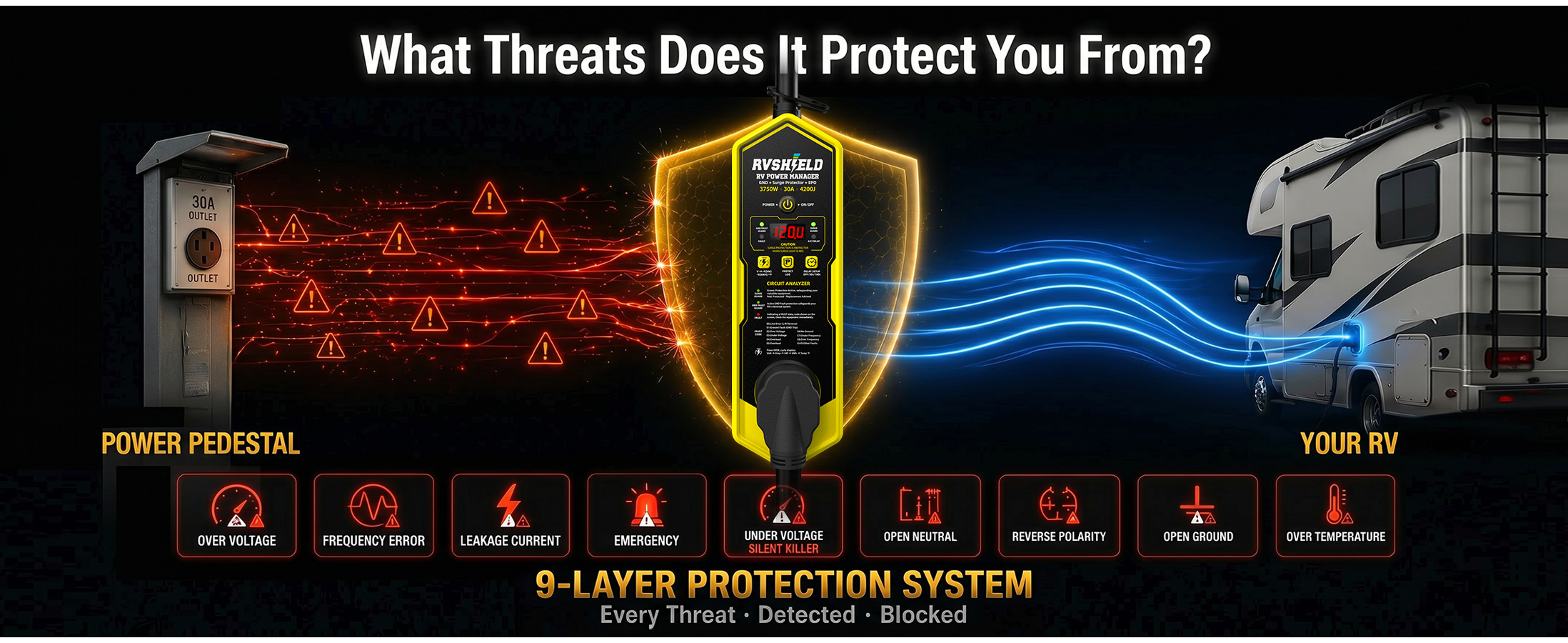
RVShield continuously monitors your shore power for nine categories of electrical faults. When any of these conditions is detected, the Emergency Power Off (EPO) circuit trips in under 25 milliseconds — cutting power before damage reaches your RV systems.
Campground transformers can develop high voltage conditions. Over-voltage is the fastest way to burn out motor windings in your AC, refrigerator, and water heater.
Under-voltage causes motors to draw more current than they're designed for, generating excess heat and shortening compressor life significantly.
Generator-supplied power or heavily loaded campground grids can run at abnormal frequencies. Motor-speed-sensitive appliances are at risk.
A missing or disconnected ground conductor means your RV chassis has no safety path to earth. Any fault current would seek ground through your body instead.
An open neutral can cause voltage to rise to dangerous levels on one half of your RV's 120V circuits, potentially destroying appliances and creating fire risk.
Hot and neutral reversed at the pedestal. Creates shock risk from any appliance frame that's supposed to be at neutral potential. Not detectable by plug-in testers.
Draws exceeding the rated 30A load are detected and tripped before the breaker at the pedestal trips — protecting both your wiring and the campground panel.
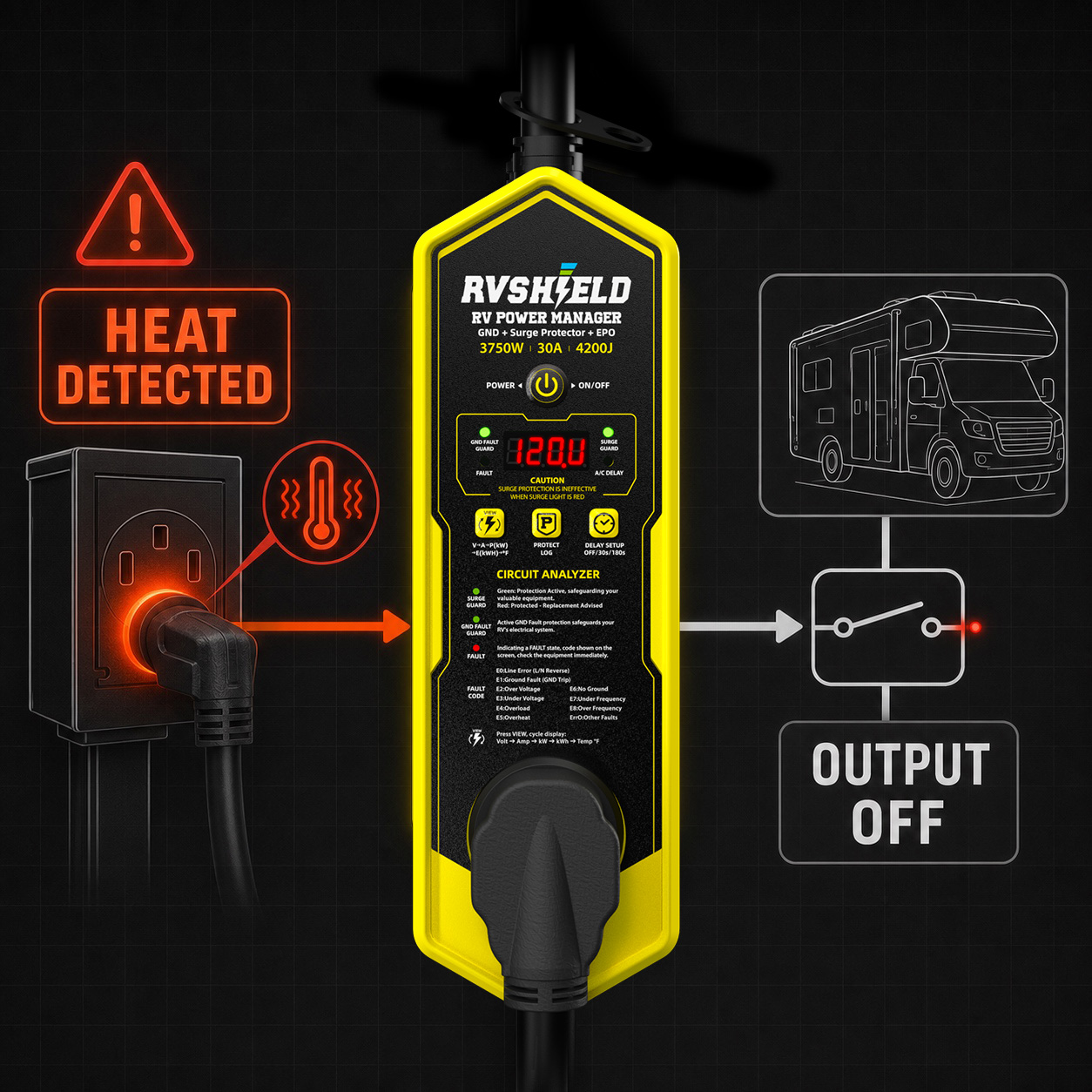
Internal temperature monitoring with automatic power cutoff at 200°F. Prevents the device itself from becoming a fire hazard — see the thermal section below.
Equipment-level ground fault detection at 30mA threshold. Detects wiring faults and insulation failure within your RV's 120V systems before they cause damage.
Emergency Power Off (EPO) trips in under 25 milliseconds when any fault condition is detected. For reference, most surge-induced damage happens within the first 8–20ms of exposure. Speed matters.
When a generic surge protector trips, it shows you a red light. You're left with no information: was it a power surge? Low voltage? An open ground at the pedestal? You disconnect, wait, reconnect, and hope for the best.
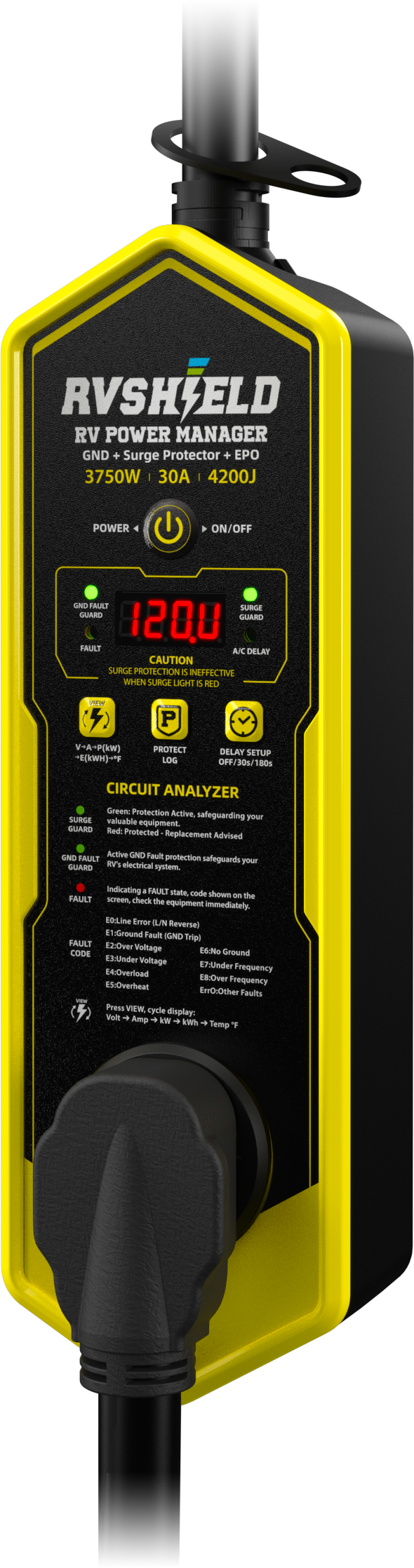
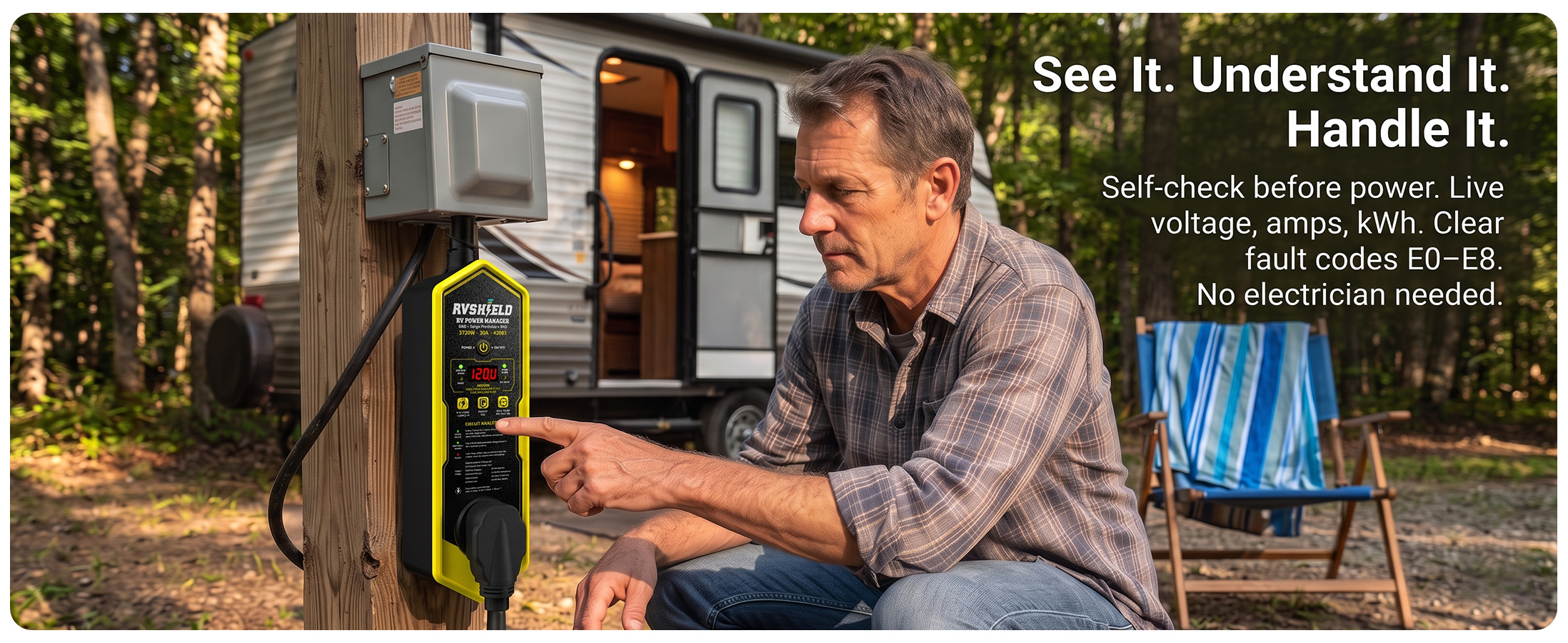
When RVShield trips, the digital tube display shows one of 10 specific fault codes. E3 means "High Voltage Detected." E6 means "Open Ground." E0 means "Reverse Polarity." You know exactly what happened — and whether it's safe to reconnect.
The Protect Log records up to the last 100 fault events with timestamps, giving you a campsite power history you can reference or share with campground staff when reporting a pedestal problem.
Surge protectors contain Metal Oxide Varistors (MOVs) — components that absorb surge energy. When MOVs absorb multiple surges or are exposed to sustained overvoltage, they heat up. Without thermal protection, a degraded MOV can continue to conduct current, generating heat until the plastic housing melts or ignites.
RVShield has a built-in internal temperature sensor. When internal temperature reaches 200°F (93°C), the EPO circuit trips, cutting all power to your RV. The display shows fault code E5 (Overtemperature).
This is the same thermal auto-shutoff principle used in quality-grade electrical appliances — and it's absent from most consumer surge protectors in this category.
Combined with the -40°F cold rating, the operating envelope covers every North American climate: from Minnesota winters where competing products fail above freezing, to Arizona summers where sustained high-load operation can stress MOVs beyond their thermal limits.
Most RV surge protectors use standard MOVs rated for 0°C (32°F) to 85°C ambient. Below freezing, MOV resistance characteristics shift, causing false fault detection — exactly the E6 errors seen in hundreds of reviews of competing products. RVShield uses components rated to −40°C, eliminating cold-triggered failures entirely.
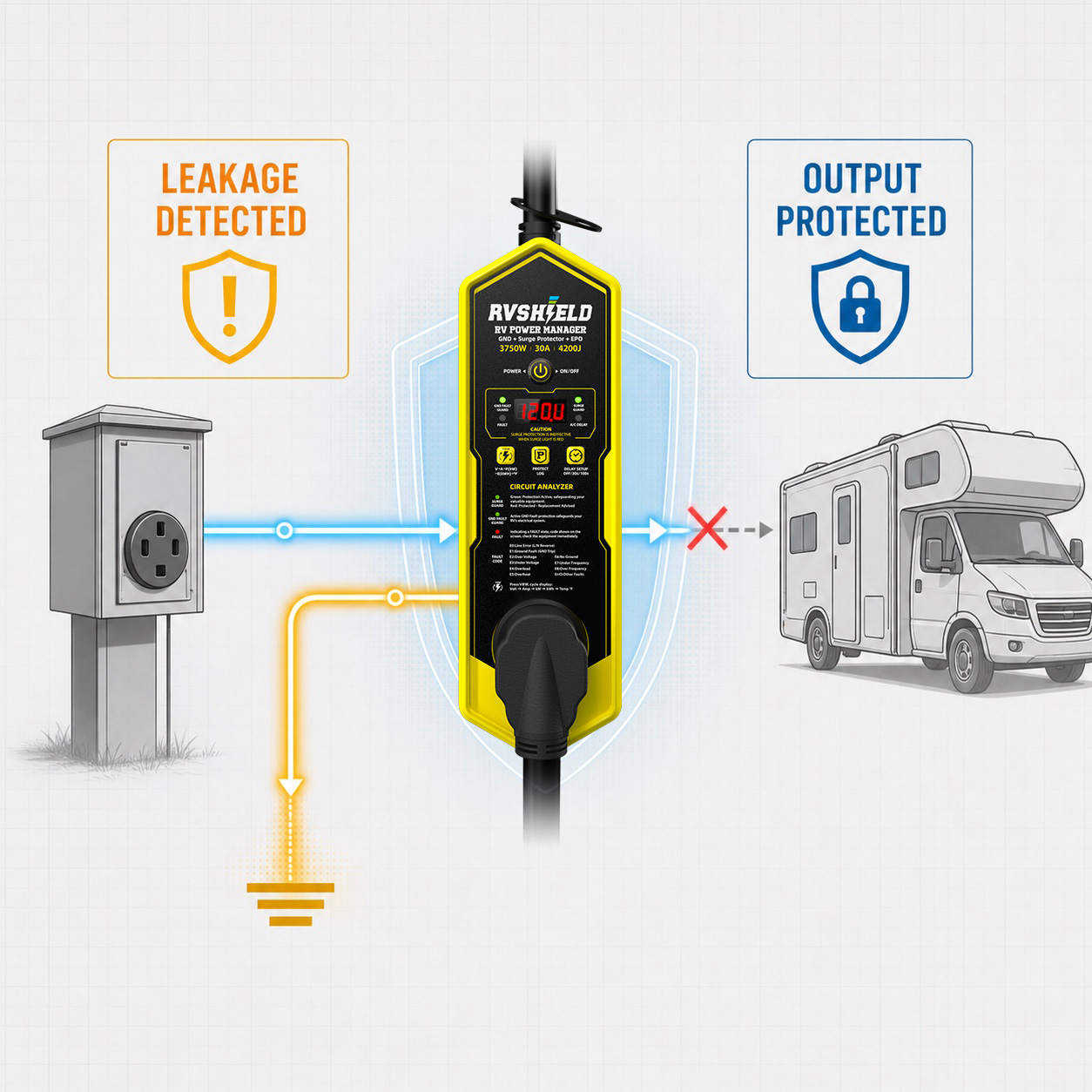
RVShield monitors for ground fault leakage current at a 30mA threshold, responding in under 25 milliseconds when a fault is detected.
Ground faults occur when current finds an unintended path to ground — through damaged appliance wiring, corroded connections, or moisture in your RV's electrical system. Detecting this condition early prevents insulation damage from propagating into a full wiring fault.
This is equipment-level ground fault detection — designed to protect your RV's electrical systems and appliances from damage caused by sustained fault current. It detects wiring issues and leakage within your RV's 120V systems.
Standard GFCI outlets (personal shock protection) trip at 5mA, designed to prevent electrocution. RVShield's 30mA ground fault detection operates at the equipment-protection threshold — the appropriate level for a power monitoring device protecting RV electrical systems. These are complementary layers of protection serving different functions.
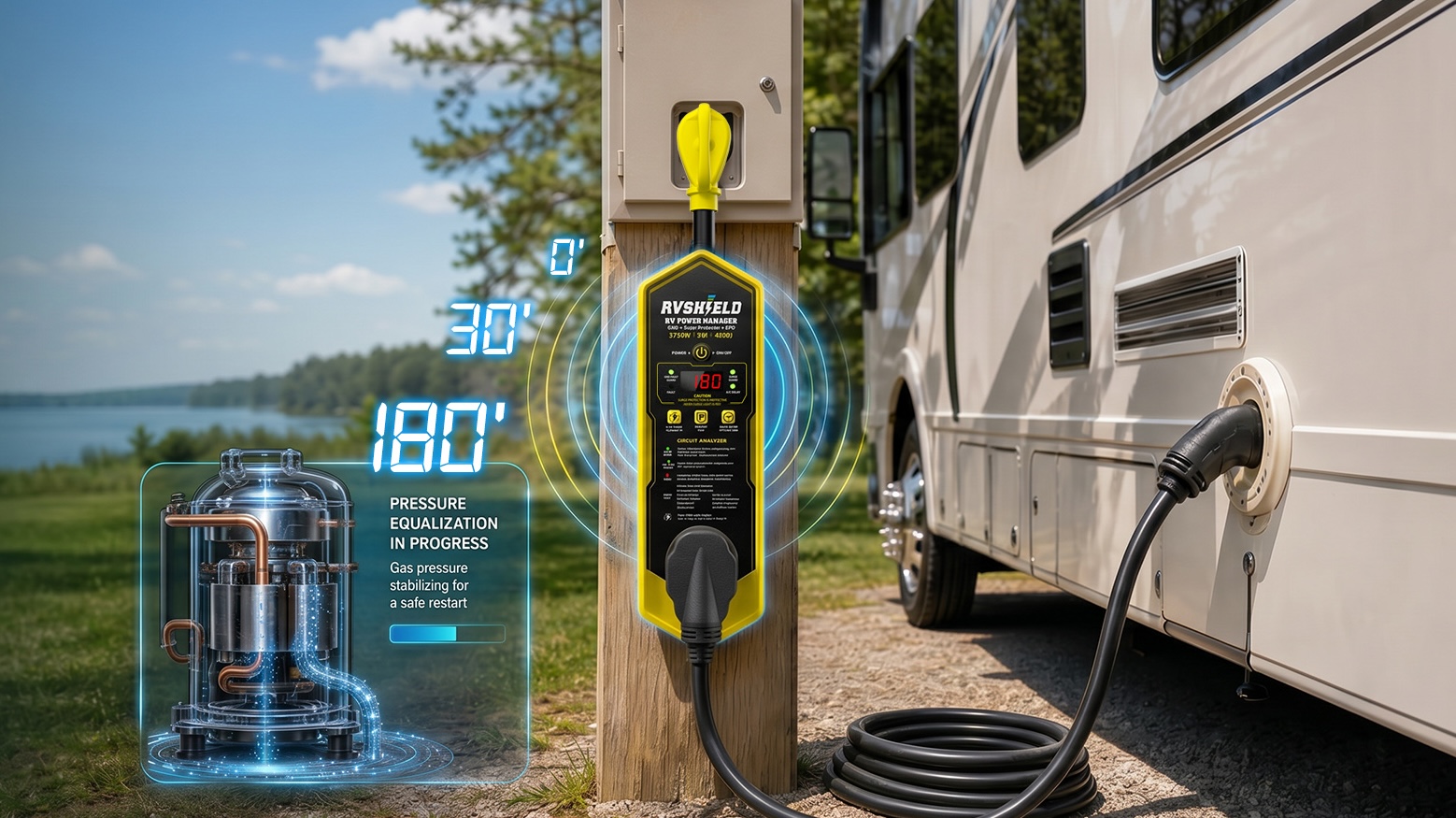
Every RV air conditioner has a compressor. Restarting a compressor too quickly after a power interruption — before internal pressures equalize — can cause the motor to lock up and stall. That stall draws enormous current, overheats the windings, and can permanently damage or destroy the compressor. Repairs run $800 to $2,400.
All other surge protectors enforce a fixed delay (typically around 2 minutes). RVShield gives you three choices — matched to your situation.
A fixed 2-minute delay means: if you're plugging in at a new campsite (never an interruption), you still wait 2 minutes before your AC starts. If you have a momentary 1-second power blip, you wait 2 full minutes. RVShield's three-mode selector matches protection to your actual situation — not a worst-case assumption applied universally.
Many monitors in this category use a cycling display — the screen rotates through voltage, amperage, frequency, and wattage in sequence. You see each reading for about 2 seconds before it disappears and the next appears. If you glance at it at the wrong moment, you miss the reading you needed.
RVShield uses a digital tube (seven-segment LED) display configured to show all five readings simultaneously: Voltage (V), Current (A), Frequency (Hz), Power (W), and cumulative kWh Energy. No cycling. No waiting. Always there when you look.
The kWh energy tracking is exclusive to RVShield in the 30A surge protector category. It accumulates total energy consumption across your current stay — useful for understanding your RV's real consumption patterns, monitoring extended boondocking periods, and tracking energy costs at paid hookup sites.
NEMA 3R (equivalent IP33/IP34) weatherproof rating means the housing is designed to protect internal components from rain, sleet, and snow. The enclosure keeps water out under any typical outdoor use condition — including wind-driven rain during a campground storm.
The $144 premium competitor in this category has accumulated 150+ reviews documenting water entering the enclosure, condensation damage, and units failing after exposure to rain. At the price point, buyers expect better — and get the same unprotected plastic box everyone else uses.
The RVPM-30A housing uses a sealed design with drainage provisions to prevent water pooling. The TT-30P plug and TT-30R receptacle connections are the point of highest moisture exposure — both are designed to maintain their weatherproof rating when connected to a campground pedestal.
Available now on Amazon with same-day Prime shipping to most of North America.